How to Get More Wedding DJ Bookings: Where Leads Come From
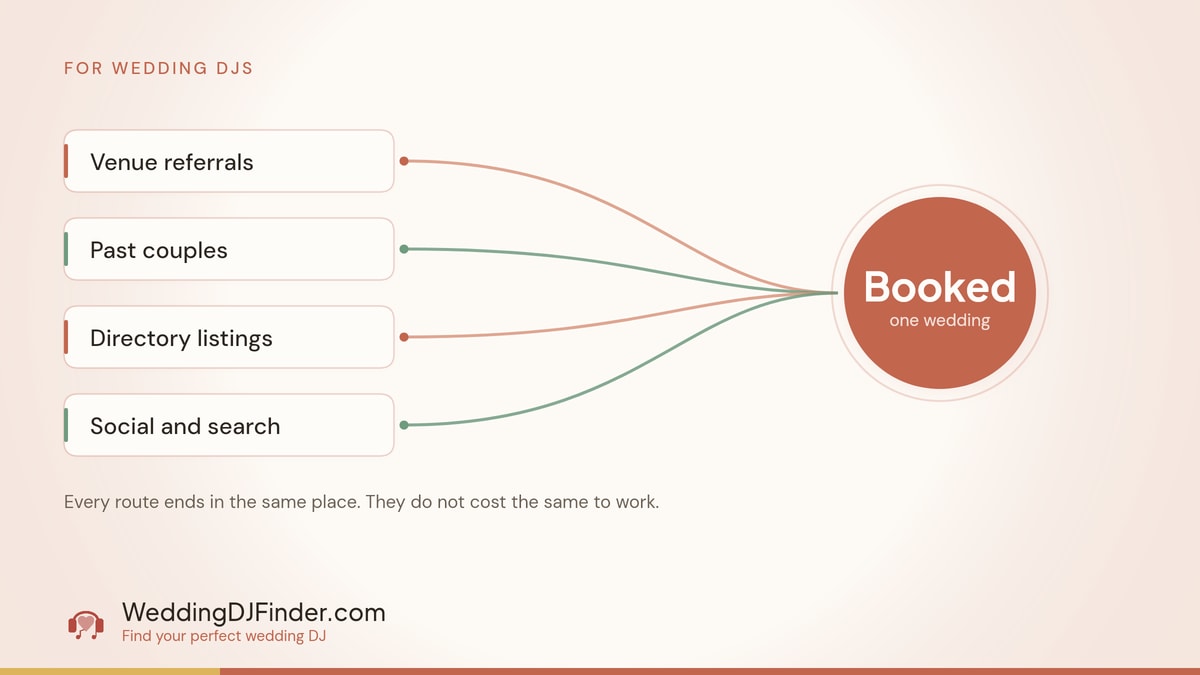
Most DJs can tell you where their last booking came from. Almost none can tell you where their last ten came from. That gap is why marketing spend in this business is mostly superstition.
This one is written for DJs. If you are a couple trying to find and compare DJs, our wedding DJ cost and price guide is the page you want, and it will serve you better than this one will.
Still here? Then you have an uneven calendar, and you have either paid for a big-platform listing and could not tell whether it worked, or you are about to. This is a channel-by-channel accounting of how to get more wedding DJ bookings, with the real cost, the real conversion rate, and the real ceiling of each one. Including ours, and we will tell you where ours is weak.
The takeaway up front: every channel has a ceiling, and you cannot pick between them until you write down which of your last ten bookings came from where.
Why most wedding DJ marketing spend is superstition
Ask a DJ why they renew a listing and you will usually get a story about one booking. A good one, a memorable couple, a number they still remember. One data point, recalled emotionally, standing in for a whole channel.
Meanwhile the channel that actually produced four of the last ten gets no credit, because it was slow and quiet and nobody sent an invoice for it.
You cannot fix this with better instincts. You fix it by writing the sources down, which almost nobody does, which is why the DJ who does it has an edge that costs nothing.
Venue and planner referrals: highest conversion, hardest ceiling
A DJ who comes recommended by the venue coordinator is not competing. The trust transferred before the couple ever heard your name, and the close rate reflects that. Ask any DJ with a strong venue relationship what their booking rate is on those leads and the number will be uncomfortably higher than everything else they do.
Three things are true about it at the same time.
It is the slowest channel to build. You get on a preferred list by being easy to work with over multiple seasons, not by asking. Show up early, do not fight the coordinator over timeline changes, tear down without leaving the room a mess, and follow up with a thank you that is not a pitch.
It does not scale on demand. When February is thin you cannot turn referrals up. The pipeline was set months ago.
And it quietly caps your price. You get referred at the tier of the venues that know you. If your relationships are all with $8,000 barn venues, you will be quoted against DJs priced for $8,000 barn venues, no matter how good you are. Moving up a tier means building new relationships, not raising your number.
One concrete step most DJs miss: your venues already have a page on WeddingDJFinder, and claiming it is free. A claimed venue can endorse preferred DJs, and a confirmed endorsement shows on their page and on yours. If you have three venues that genuinely like you, that is a fifteen-minute email and a real asset.
Past guests: the channel nobody tracks
Somebody standing on your dance floor tonight is getting married in eighteen months.
This is the highest-quality lead in the business and it is almost entirely unmanaged, because the DJ has no way to reach them later. Nothing sophisticated is required. A name people can remember and a searchable presence eighteen months later is most of it.
Which is the point. This channel mostly resolves into "can they find you again," and that lands on the two owned assets below.
The Knot and WeddingWire: what you are actually buying
Let us be straight about this one, because most of what a DJ reads about it is written by someone selling an alternative.
The audience is real and it is enormous. WeddingPro, the vendor side of The Knot and WeddingWire, reports 15 million monthly unique visitors and roughly 2.4 million couples signing up to search each year. No other channel on this page puts you in front of that many couples. And a basic storefront on both sites is free with no credit card, which means the argument is never "should I be on there at all." You should. It costs nothing.
The argument is about the paid tiers. One 2026 industry breakdown puts listing-tier fees at $50 per month to over $1,200 per month depending on market and placement, with higher-tier placement in competitive metros commonly quoted at $6,000 to $12,000 a year.
The structural thing to understand is not the price. A couple browsing a directory messages several vendors in one sitting, so above a free listing you are largely buying placement in a race you then have to win on response time and on how your storefront looks next to the four DJs beside it.
That is not a criticism of them. It is how directories work, and it is how ours works too. A couple who finds you on WeddingDJFinder is probably also messaging two other DJs on WeddingDJFinder. Any DJ who tells you their directory delivers exclusive wedding leads is selling you something.
Where the paid tier genuinely earns out: crowded metros where you cannot rank organically, DJs who answer inquiries within the hour, and DJs whose photos and reviews hold up against the listing next to them. Where it does not: thin markets you already dominate, and DJs who let an inquiry sit until Tuesday. If that is you, the money is better spent on the two free channels below.
Pay-per-lead marketplaces like Thumbtack
Different model, different failure mode. Thumbtack is not wedding specific, and you pay per lead when a customer reaches out to you, with the price set by job type, job size, market, and how competitive you choose to be on their slider.
Two consequences. First, lead quality varies hard: the same platform matches people who want a DJ for a wedding and people who want a DJ for a graduation party. Second, you are paying per contact, and a contact is not an inquiry. Some are price shoppers, some never respond after the first reply, and you paid the same for those as for the real ones.
It can work for filling non-wedding dates. Just do not run it against your wedding rate expectations, because the buyer on the other end is usually not that buyer.
Google Business Profile: free, owned, and badly underused
This is the one most wedding DJs leave on the table entirely.
Google's own documentation says local results are based on relevance, distance, and prominence, and that there is no way to request or pay for a better local ranking. You cannot buy the local pack. You can only earn it, which is exactly why it is worth your time when everyone else is buying placement somewhere else.
What actually moves it, from that same page: complete and detailed business information, the right category, current hours, photos, and reviews. Google states plainly that more reviews and higher ratings affect local ranking, and that replying to reviews matters.
Practical version for a DJ:
- Set your primary category to DJ, and add wedding-specific secondary categories rather than leaving it generic
- Set a service area that matches the radius you actually travel, not your whole state
- Add real photos from real weddings, and keep adding them, not once at setup
- Ask every couple for a Google review, not just a review on the platform that sent them
- Reply to every review, including the mediocre ones
This channel is slow for about three months and then it compounds, and nobody can outbid you for it.
Your own website: slow, compounding, yours
Everything above rents you an audience. Your site is the only place where the traffic, the reviews, the photos, and the inquiry form are yours, and where nobody can reprice you next renewal.
It is also genuinely slow. A new site is not producing wedding inquiries this season. Treat it as the asset the other channels point at rather than as a channel that carries you.
Niche directories, including us
Here is the straight version.
A free listing on WeddingDJFinder puts you on the city and state pages for your market with a basic profile, up to 3 photos, and 1 free lead so you can see what an inquiry from here actually looks like before you decide anything. That is $0 and it stays $0.
Pro is $59 a month (or $47 a month billed annually) and removes the lead cap, adds 20 photos and a video reel, priority placement, analytics, the Pro badge in search results, and the full DJ Tools Suite. Founding DJ is the same at $29 a month locked forever, limited to the first 100 DJs. There is a 30-day free trial with no credit card required, and the current pricing has all of it.
Now the honest part. A niche directory is a smaller pond, which cuts both ways. Fewer DJs are competing for the same inquiry, which is good. Total volume is lower than a platform with 15 million monthly visitors, which is not. If you work a market where our coverage is thin, a paid tier here will underperform a paid tier there, and you should not take our word over your own numbers. Start free, watch a month of inquiries, then decide.
Putting the channels side by side
| Channel | What it costs | Conversion | Speed to results | Ceiling |
|---|---|---|---|---|
| Venue and planner referrals | Time, over seasons | Highest | Slowest | Capped at the venue tier that knows you |
| Past guests | Near zero | High | 12 to 24 months | Bounded by how many floors you play |
| The Knot / WeddingWire free storefront | $0 | Moderate | Weeks | Visibility below paid tiers |
| The Knot / WeddingWire paid | $50 to $1,200+ a month | Moderate, response-time dependent | Immediate | Renews at their price, not yours |
| Pay-per-lead marketplaces | Per contact, market dependent | Lowest | Immediate | Lead quality, not volume |
| Google Business Profile | $0 plus your time | High | About 3 months | Your service radius |
| Your own website | Hosting plus time | Highest | 6 to 12 months | Whatever you drive to it |
| Niche directories | $0 to $59 a month | Moderate | Weeks | Directory coverage in your market |
Read that table against your own market. A DJ in a metro with 150 competing DJs and a DJ in a market with 12 are not making the same decision. Our 2026 industry report has the per-city supply numbers.
The actual deliverable: your last ten bookings
Do this before you renew anything.
Open your calendar, go back through your last ten booked weddings, and write the source next to each one. Not "online." The specific source. Which venue, which past couple, which platform, which search.
Then three questions.
Which channel produced the most bookings? That is where your next hour goes, and it is very often not where your next dollar was going.
What did each booking cost you? Divide what you paid that channel over the year by the bookings it produced. A $600 annual listing that produced two $1,600 weddings is fine. The same listing producing zero for two years is a subscription you forgot about.
Which channel produced your best-paid weddings, not just your most? These are frequently different channels, and the volume one gets the credit while the revenue one gets ignored.
If a channel produced nothing for two consecutive seasons, cut it. If one produced four of ten and you have never deliberately worked it, that is your season.
Ten bookings is a small sample and you will not get statistical certainty out of it. You will get something better: the end of guessing.
Frequently asked questions
Is The Knot worth it for DJs?
The free storefront is worth it for everyone, since it costs nothing and the audience is the largest in the category. The paid tiers are worth it in crowded metros where you cannot rank organically, if you answer inquiries fast and your storefront holds up next to the DJs beside it. In a thin market you already dominate, or if inquiries sit in your inbox for two days, the same money does more on Google Business Profile and your own site.
How do wedding DJs get bookings without paying for ads?
Venue and planner relationships, Google Business Profile, past guests, and free directory listings. All four are free, all four are slower than buying placement, and all three of the free owned ones compound instead of resetting every renewal. The tradeoff is real: free channels cost time you have to actually spend.
How many wedding leads should I expect from a directory listing?
There is no honest industry number. It swings on your market's DJ supply, your photos, your reviews, and how fast you reply. Start on a free tier, measure one month, and let your own inquiry count answer it instead of anyone's marketing page.
Should I be on every platform at once?
Be on every free one. Every free listing is a place a past guest can find you again eighteen months later. Pay for at most one at a time, give it a full season, and measure it against your last-ten list before adding a second.
Where to go from here
Write down your last ten bookings and their sources this week. It takes twenty minutes and it will change one decision you were about to make on instinct.
Then claim the free things. Your Google Business Profile, your free storefronts, and your listing here. WeddingDJFinder was built for DJs by a DJ.
Claim your free listing and see what a month of inquiries looks like before you pay anyone anything.
Read the 2026 Wedding DJ Industry Report for current pricing benchmarks, demand trends, and booking insights.
The DJ Tools Suite is included with Pro
Pro includes Song Requests, Timelines, Music Plan, Contracts, Quotes & Invoices, Review Requests, Book-me Widget, and Pricing Insights, plus unlimited leads and priority placement in search. There is a 30-day free trial, no credit card required.
See what Pro includes