How Much to Charge for Wedding DJ Services: 2026 Rate Guide
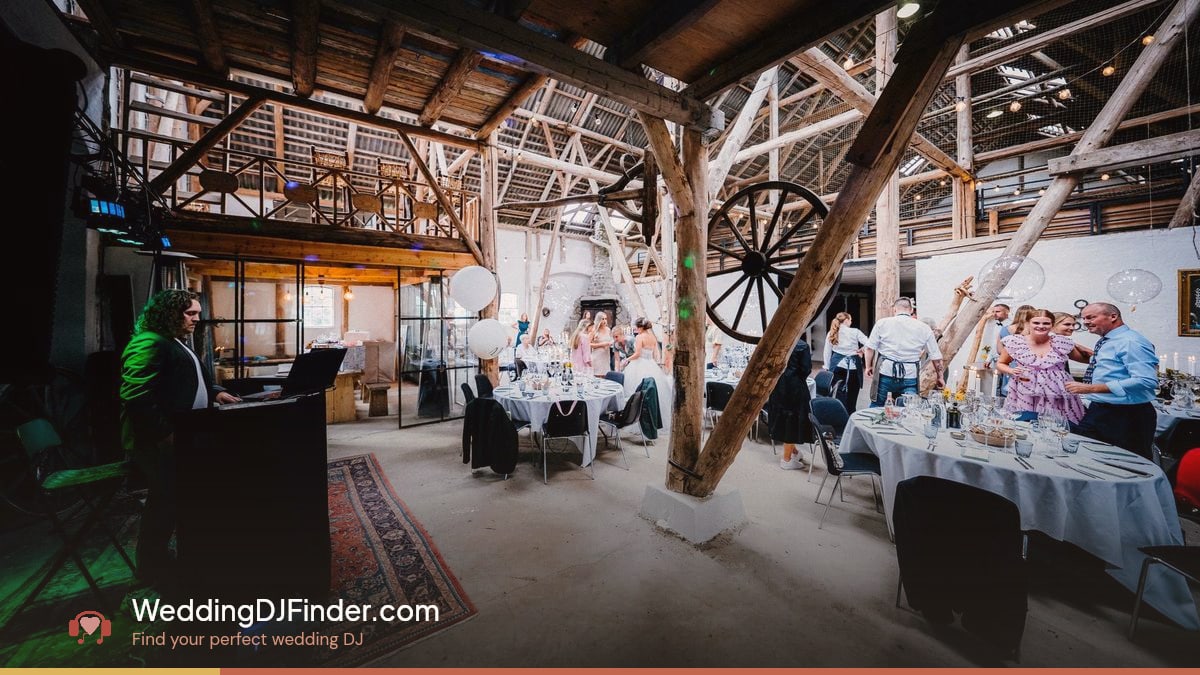
If you cannot say what the DJs one tier above you charge in your own market, you are not pricing. You are guessing.
This one is written for DJs. If you are a couple who landed here trying to work out what a wedding DJ costs, you want our wedding DJ cost and price guide instead, and you will get a straighter answer there than you will here.
Still with us? Then you already have bookings. Ten to forty weddings a year, real contracts, and a quiet suspicion that your number is too low. This is about how much to charge for wedding DJ work when you set the rate deliberately instead of by nerve.
The short version: your rate is a position in your market, not a number you pick. And you can only set a position once you can see where the rest of the market actually sits.
Why gut-feel pricing drifts down every season
Here is the mechanism, and it is worth understanding because it is not a discipline problem.
You only ever get feedback from the couples who said yes.
The couple who opened your inquiry reply, saw $1,200, and quietly moved on never tells you they moved on. Neither does the couple who saw $1,200, decided you could not be the caliber they wanted for a $40,000 wedding, and booked someone at $2,400 instead. You get filtered out in both directions and hear about neither. What lands in your inbox is a survivorship sample: the people for whom your number was acceptable.
So the loop you actually run is "nobody flinched at $1,200." Which becomes $1,200 next season, and the season after that, while your insurance renewed higher, a controller died and got replaced, and the venues you work started charging their own couples more.
Two data points worth holding next to each other. The Knot's Real Weddings Study puts the average cost of a reception DJ at $1,800, against $4,500 for a live band, drawn from a survey of 10,474 US couples married in 2025. On our side, the 398 DJs who published a rate in the data behind our 2026 industry report had a median of $1,400.
Those are not measuring the same thing. One is what couples report spending, the other is the midpoint of ranges DJs choose to publish, and a published range usually starts at the floor. Treat the gap as directional, not as proof. But if your own number is well under $1,400 and you are not in a genuinely cheap market, that is worth sitting with.
How much to charge for wedding DJ work starts with your own market
It is not the national average. The national average is a trivia answer and it will not set your rate.
What you need is the distribution in your own market, and where you sit inside it.
Across the DJs who publish pricing in our 2026 industry report data, the national median is $1,400, the 25th percentile is $650, and the 75th percentile is $2,685. Half the field sits somewhere in a $2,000-wide band. There is no "the rate." There is only where you are standing. Our wedding DJ cost pages track the same published-rate data by state and update as DJs change their pricing, so check the one for your state before you touch your number.
Then it gets more specific, and this is the part that should change how you think. City by city, the report found:
| Market | Median published rate | DJs publishing a rate |
|---|---|---|
| Boston, MA | $2,900 | 5 |
| Chicago, IL | $2,450 | 6 |
| San Diego, CA | $2,350 | 4 |
| Atlanta, GA | $1,650 | 2 |
| Raleigh, NC | $498 | 2 |
| Seattle, WA | $360 | 4 |
Read the last column before the middle one. Two to six DJs per city is a thin sample, so treat any single number here as directional, not as a price list. Even allowing for that, the gap between the top and the bottom of this table is wide: the Boston DJs who publish a rate sit around eight times the Seattle ones. Nobody in Seattle is worse at this. The market is a different market.
That is the whole argument in one table. A DJ charging $2,900 in Boston is not better than a DJ charging $1,400 in a mid-tier market. They are positioned differently in different rooms. And if you are working Boston-tier venues on Seattle-tier numbers, getting better at your craft will not fix it, because it was never a craft problem.
The catch: you cannot see any of this by browsing. In the dataset behind that report, 95.8% of wedding DJ profiles listed no rates at all, which is also why the city samples above are so small. The information you need to price against is hidden by almost everyone holding it, including, probably, you.
Build a package ladder, not a single number
A single number turns every conversation into a discount negotiation. There is only one lever and the couple knows where it is.
A ladder turns it into a scope conversation, which is a conversation you can win.
A structure that holds up in most markets:
Base. Reception only. A stated block of hours, one setup, MC duties, full sound for the room, basic dance floor lighting. This is your floor and it should be a number you are genuinely happy to work for, not a bait rung.
Base plus ceremony. A second system at a second spot, a wireless lav or handheld, early arrival, and cues you cannot be late for. Price it for what it is: a second load-in and a second point of failure on the same day. Most DJs underprice this rung badly.
Plus design. Uplighting, dance floor wash, a monogram. Our wedding DJ add-ons cost guide covers what the market currently bears on each of these, which is useful when you are setting your own numbers on that rung.
Plus planning depth. Detailed timeline build, unlimited planning calls, custom edits and mashups, a full music plan locked weeks out.
One rule governs the whole ladder: every rung has to add cost or risk that you actually carry. If a rung is just a bigger number for the same night, couples can feel it, and so can you when you are trying to say it out loud on a call.
What should move your number, and what should not
Things that should move it:
- Total hours on site, counting load-in and teardown, not just the hours you are performing
- Travel past whatever radius you decide is free
- A second setup or a second location
- Ceremony sound
- Load-in difficulty: stairs, no elevator, a 200-foot cable run, a venue with a 4pm access window
- Peak date. A Saturday in September is not a Friday in February
- Gear depth, specifically redundancy. A full backup rig that has never been used is still a real cost you are carrying for them
- Short lead time
Things that should not move it:
- How much you like the couple
- How much you need the booking this month
- Whether the last couple flinched
- What someone in a Facebook group charges in a market you do not work in
- Whether it is a "small wedding"
That last one is the most common self-inflicted discount in this business. A 60-person wedding is the same load-in, the same hours, the same Saturday, and often the same planning as a 200-person wedding. Guest count is the couple's cost driver. It is not yours.
Put overtime, travel, and peak dates in writing before the night
Every one of these is easier as a printed line than as a conversation.
Overtime. Put a per-hour or per-half-hour rate in the contract. The point is not the money. It is that at 10:45pm, with the father of the bride asking for one more hour and the room still full, you should not be inventing a number under pressure. A stated rate is faster and kinder to both of you.
Travel. Free inside a stated radius, then a per-mile rate or a flat zone fee past it, plus the distance at which an overnight joins the quote. Write the radius down. "Depends where it is" is how you end up eating a three-hour round trip.
Peak dates. If you charge more for the fall Saturdays, name them on the quote, not after the couple has fallen in love with the price they saw first.
A couple who reads a clear travel policy does not read it as nickel-and-diming. They read it as a business. The DJ with no stated policy who then asks for gas money in the final week is the one who looks like they are making it up.
How to raise your rate without losing your referral base
Three rules, and they work together.
Raise on new inquiries only. Everything already quoted gets honored, including the quote you sent last Tuesday that has not come back yet. No exceptions and no awkward emails.
Say nothing publicly. No announcement, no "prices are going up January 1" post, no email to past clients. Nobody needs to be told, and telling them only opens a conversation you would rather not have.
Decide your referral rule in advance. When a past couple sends someone your way, you are allowed to hold the old number for that one booking. It costs you a few hundred dollars and it protects the chain that produced the referral in the first place. Decide whether you will do that before an actual referral is sitting in your inbox, so you are not making the call while emotionally invested in it.
On size: 10% to 15% in a season is essentially invisible to the market. 40% in one jump is not, and it will show up in your booking rate.
What to do when you find out you are well under market
Not a single leap to the top of the range. Two reasons, and both are practical.
First, your materials have to catch up. Photos, reviews, your website, and the way you write an inquiry reply all read as a price tier. A couple who gets a $2,800 quote attached to three blurry photos and no reviews does not conclude that you are undiscovered. They conclude something is off.
Second, a huge jump teaches you nothing. If your booking rate collapses, you cannot tell whether the number was wrong or the presentation was.
So stage it. Move to roughly the 40th to 50th percentile of your market first. Hold it for eight to ten inquiries, which is a real sample rather than a bad Tuesday. Then look at what happened, and go again if it held.
And watch the right number. It is not booking rate, it is revenue. If your booking rate falls from 50% to 35% while your rate went up 30%, you made more money and gave up fewer Saturdays. That is the trade you were trying to make.
One honest caveat: at four inquiries a month, eight to ten inquiries is most of a season, and you are working from thin data the whole time. That is a reason to fix inquiry volume alongside pricing, not a reason to stay flat while you wait.
Seeing what your own market actually charges
Everything above depends on one input, and it is the one input most DJs do not have: what the DJs around you actually charge, by tier, in your city.
You can get it for free. Call five DJs in your market, tell them the truth about why you are asking, and some will tell you. That genuinely works and it costs nothing. It is just slow and a little awkward, which is why almost nobody does it.
The faster version is Pricing Insights, one of the eight tools in the DJ Tools Suite included with Pro on WeddingDJFinder. It shows what DJs charge in your market and where your number sits against them, which is the exact gap this article has been describing.
Two honest notes. In a thin market the sample is small, so treat the output as directional rather than as gospel. And if you are not ready to pay for anything, a free listing is $0 and stays $0: a basic listing, up to 3 photos, and one free lead so you can see what an inquiry from here looks like.
If you do want the tools, the current pricing is Pro Monthly at $59/month or Pro Annual at $47/month billed at $566 for the year, and Founding DJ is $29/month locked in forever while the first 100 spots last. There is a 30-day free trial with no credit card required.
Frequently asked questions
How much should I charge for a 5 hour wedding as a DJ?
There is no single right answer, because a five-hour reception in Boston and one in Raleigh are different products in different markets. Start from your market's median, then position against it based on your reviews, your photos, and how deep your planning process goes. If your market's median is $1,400 and you have fifteen strong reviews and real reception photos, the bottom of the range is not where you belong.
Should I put my wedding DJ prices on my website?
Almost nobody does. In the data behind our 2026 industry report, 95.8% of DJ profiles listed no rates at all. Publishing filters out couples who were never going to book you, which saves inquiry time, but it also removes your ability to price a hard load-in or a peak date differently. A stated starting price ("receptions from $X") is the middle ground most DJs land on.
How much should I raise my wedding DJ rates each year?
If you are roughly where you want to be, 5% to 10% a year keeps you level with costs without anyone noticing. If you have discovered you are well under market, that is a repositioning rather than an annual increase, and it should be staged over a season or two.
What is a normal deposit for a wedding DJ?
Most DJs take between 25% and 50% to hold the date, with the balance due shortly before the wedding. Whatever you pick, make it non-refundable in writing and make the date-hold logic explicit, because a held Saturday is the actual thing you are selling.
Where to go from here
Pick one thing off this page and do it this week. Write down your travel radius. Put an overtime rate in the contract. Or find out, for real, what the tier above you charges in your city.
If you have not claimed your listing yet, that part is free, and it is where the market data lives. WeddingDJFinder is built for DJs by a DJ.
Claim your free listing. It costs nothing, it stays free, and it is the step that puts you inside the market you have been guessing at.
Read the 2026 Wedding DJ Industry Report for current pricing benchmarks, demand trends, and booking insights.
Claim your free WeddingDJFinder listing
Your listing is free and stays free: a profile couples find when they search your city, up to 3 photos, and 1 free lead so you can see what an inquiry from here looks like before you decide anything.
Claim your free listing