Wedding DJ Add-Ons: Real Costs and What's Actually Worth It
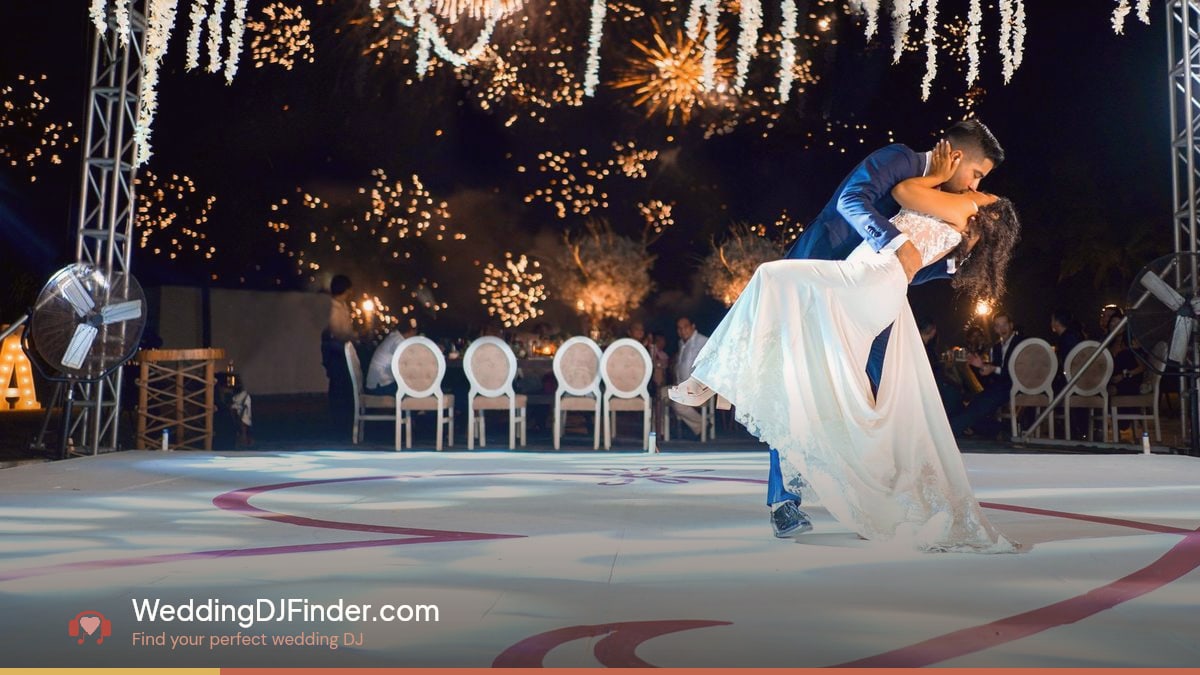
Your DJ quote came back with a base package and then a menu: uplighting, photo booth, dance floor wash, monogram, cold sparks, ceremony sound, extra hour. Each line has a price next to it and no explanation of what it actually does for your wedding.
Here is the decoder. Below is a worth-it or skip-it read on every common wedding DJ add-on, what a fair price range looks like, and the exact situations where each one earns its cost.
One thing first. Add-ons are not a scam. Most of them are real gear that costs real money to own, haul, set up, and insure, and a DJ who lists them separately is being more honest than one who buries everything in a single padded number. The question is never "is this DJ upselling me." It is "does my venue and my guest list actually need this."
The short answer on wedding DJ add-on costs
Most wedding DJ add-ons run 150 to 900 dollars each. Uplighting is typically 300 to 800, a photo booth 500 to 1,200, ceremony sound 200 to 500, and extra hours 150 to 300 per hour. A base DJ package plus two add-ons is the most common real-world booking.
What each wedding DJ add-on costs at a glance
| Add-on | Typical range | Worth it when |
|---|---|---|
| Uplighting | 300 to 800 | The room is plain, dark, or has white walls |
| Photo booth (open-air) | 500 to 900 | Guest count over 100, long reception |
| Photo booth (360) | 900 to 1,500 | Younger crowd, social-heavy wedding |
| Ceremony sound | 200 to 500 | Ceremony is in a separate space or outdoors |
| Dance floor lighting | 150 to 400 | Venue lighting is flat or all-on |
| Monogram projection | 150 to 350 | You want one strong photo detail |
| Cold sparks | 400 to 900 | Venue approves them in writing |
| Karaoke | 150 to 400 | Your crowd already does karaoke |
| Extra hour | 150 to 300 | Your timeline is genuinely tight |
Those are quote ranges, not rules. A DJ in Chicago or Austin will price higher than one in a smaller market, for the same reason the base package does. If you want the full picture on base pricing before you layer anything on top, our wedding DJ pricing guide explains what each package tier includes, and wedding DJ costs by state has the current numbers, built from the prices DJs list on their profiles.
Uplighting: what it does to a room, and when it does nothing
Uplighting is a set of wireless LED cans placed around the perimeter of the room, aimed up the walls. Typical package is 8 to 20 fixtures, color matched to your palette, set before guests walk in.
What it actually does: it changes the color and depth of the entire room in photos. A beige ballroom with white walls becomes a deep amber or blush space. This is the single biggest visual return per dollar of any DJ add-on, and it is the one most couples underestimate until they see the before and after.
Worth it when: your venue is a plain hotel ballroom, a white-walled event hall, a barn interior, or any room where the walls are the dominant visual and nobody is dressing them. Also worth it if your reception runs past dark and the venue lighting is harsh overhead fluorescents.
Skip it when: your venue already has architectural lighting, exposed brick with warm fixtures, floor-to-ceiling windows with a real view, or heavy draping and florals covering the walls. In those rooms uplighting competes with what you already paid for. Also skip it for a daytime reception in a bright space, where you will not see it at all.
Fair price: 300 to 800 dollars for a full room. If a quote is under 200 for a large space, ask how many fixtures that is. Eight cans in a 200-person ballroom will look like eight cans in a 200-person ballroom.
Ask whether the fixtures are battery powered and wireless. Corded uplights mean extension cords taped along your walls, which is both an eyesore and a venue conversation you do not want on the day.
Photo booths: open-air, enclosed, and 360
Three formats, three very different prices and vibes.
Open-air booth puts a backdrop and a camera on a stand with no enclosure. Groups of 8 to 10 fit in a shot, it photographs well, and it takes less floor space than people expect. This is the default and usually the right call. Typical range 500 to 900 dollars for 3 to 4 hours with prints.
Enclosed booth is the classic curtained box. More privacy, sillier photos, but it handles only 3 or 4 people at a time and eats real floor space. It is the slower option at a big wedding.
360 booth is the spinning-arm video platform. It produces short clips your guests post immediately, and it draws a crowd all night. It is also the most expensive at roughly 900 to 1,500 dollars, needs a decent footprint plus clearance overhead, and it skews young. If your guest list is heavily 45-plus, the line will be short.
Worth it when: your guest count is over about 100 and your reception runs four hours or more. A booth gives people something to do in the lulls, and it produces the one photo set your guests actually keep.
Skip it when: you have under 60 guests, a two-hour reception, or you already hired a roaming second photographer. At a small wedding the booth sits empty and you paid 700 dollars for a backdrop.
The thing worth asking: is an attendant included? An unattended booth with a jammed printer at 9pm is a dead booth. Attendant coverage is the difference between an add-on that works and one that does not, and it should be stated in the contract rather than assumed. Our wedding DJ contract guide covers what else should be written down before you sign.
Karaoke and live request features
Karaoke as a DJ add-on usually means a couple of wireless mics, a lyrics screen, and a curated songbook, run for a set window rather than all night. Typical range 150 to 400 dollars.
Worth it when: your family or friend group already does karaoke. That is the whole test. If there is a group of people who reliably sing at every gathering, this add-on is the highlight of the night for a fraction of what a photo booth costs.
Skip it when: you are hoping it will loosen up a reserved crowd. It will not. A quiet room plus an open mic is a long silence, and it kills dance floor momentum right when your DJ is trying to build it.
Live request tools are different and often free. Many DJs now run a request link or QR code guests can use during the reception. That is not an upsell, it is just a feature. Ask whether your DJ offers it, and ask how they filter requests, because an unfiltered request queue is how you end up with three novelty songs in a row.
Ceremony sound: the add-on most couples underestimate
This is the one I would push hardest on, because getting it wrong is the failure guests actually remember.
Ceremony sound means a separate speaker setup at your ceremony location, plus microphones: usually a lapel mic on the officiant, sometimes a handheld for readings, and a discreet pickup so vows carry. Typical range 200 to 500 dollars.
Worth it when: your ceremony is in a different space than your reception, outdoors, in a garden or on a beach, or anywhere with more than about 60 guests. Wind, open air, and distance eat spoken word fast, and a soft-spoken officiant thirty feet from the back row is inaudible without help.
Skip it when: your ceremony and reception are in the same room, your DJ's main system already covers it, and your guest count is small enough that everyone is within a few rows. Confirm this with your DJ rather than assuming, because "same venue" and "same room" are not the same thing.
If you are outdoors, this is not optional, and neither is a real conversation about power and weather. Our outdoor wedding DJ setup guide goes through what an outdoor ceremony actually needs.
Dance floor lighting, monograms, and cold sparks
Dance floor lighting is moving heads or wash fixtures aimed at the floor, reacting to the music. It costs roughly 150 to 400 dollars on top of whatever basic light the DJ brings. It matters most in venues that keep house lights up or have no dimming control, which is more venues than you would think. Ask your venue whether the reception lights dim. If the answer is no, this add-on is doing real work.
Monogram projection puts your initials or a design on the wall or dance floor, usually 150 to 350 dollars. It is a single detail that shows up in photos and then stops being interesting. Fine if you want it, easy to cut if the budget is tight.
Cold sparks are the indoor fountain effects for your first dance or grand entrance, roughly 400 to 900 dollars. They photograph incredibly well. They are also the add-on most likely to get denied, because plenty of venues and fire marshals will not allow them regardless of the "cold" label.
Do not book cold sparks until your venue confirms in writing that they are permitted. Get it in an email, not a verbal yes from a coordinator who may not be there on your date. A deposit on an effect your venue bans is a preventable loss.
Extra hours and second-location coverage
Extra hours typically run 150 to 300 dollars each. Buy one only if your timeline genuinely needs it, not as insurance. Most receptions that feel rushed are suffering from a packed schedule, not a short one, and an extra hour appended to a badly paced night just extends the tail after most guests have left. Build a real timeline first. Our wedding reception timeline guide walks through the pacing.
Second-location coverage is when your ceremony, cocktail hour, and reception are in different places and each needs sound. This is not really an add-on, it is a second setup, and it should be priced as one. Expect it to add meaningfully to the base package because it means two rigs or one rig broken down and rebuilt mid-event. Ask specifically whether there is a second tech, because one DJ tearing down a ceremony system during your cocktail hour means nobody is running music at the cocktail hour.
How to prioritize add-ons on a fixed budget
If you have room for exactly one, and your ceremony is anywhere other than the reception room, buy ceremony sound. Nothing else on this list affects whether your guests hear your vows.
If ceremony sound is already covered, the order that gets the most return for most weddings looks like this:
- Ceremony sound, if the ceremony is separate or outdoors.
- Uplighting, if the room is plain. This is the biggest visual change per dollar.
- Photo booth, if your guest count is over 100.
- Dance floor lighting, if the venue cannot dim its house lights.
- Everything else.
Two more things worth knowing. First, bundles are usually real. A DJ quoting uplighting plus a booth together is often 10 to 20 percent under the sum of the two separately, because it is one truck and one setup window. Ask for the bundle price before you cut anything.
Second, keep the add-on spend in proportion to the base. The Knot's data on DJ versus live band costs, drawn from their Real Weddings Study of 10,474 US couples married in 2025, puts the average wedding DJ at 1,800 dollars against 4,500 for a live band, and found 71 percent of couples hire a DJ. If your base package is near that 1,800 average, two well-chosen add-ons is a reasonable ceiling. Four of them and you have quietly spent band money on a DJ. Our state of the wedding DJ industry report covers where those numbers are heading.
And if you are still choosing the DJ rather than the extras, start with how to choose a wedding DJ. A great DJ with no add-ons beats an average one with all of them, every time. That is also true of specialty rooms: a DJ who genuinely knows a Latin and reggaeton floor is worth more than any lighting package you can buy.
Frequently asked questions
How much does wedding uplighting cost?
Wedding uplighting typically costs 300 to 800 dollars for a full room, which usually means 8 to 20 wireless LED fixtures set around the perimeter and color matched to your palette. Larger rooms and higher-cost metros land at the top of that range. Ask how many fixtures the quote includes, because a low price often means too few lights for the space.
Is a wedding photo booth worth it?
A photo booth is generally worth it when your guest count is over 100 and your reception runs four hours or longer, because it gives guests something to do during the lulls. It is usually not worth it for weddings under about 60 guests or short receptions, where the booth sits idle. Confirm an attendant is included before you book.
What add-ons do most couples actually book?
The two most commonly booked wedding DJ add-ons are uplighting and ceremony sound, followed by a photo booth. Ceremony sound gets booked because it solves a real problem, and uplighting gets booked because it changes every photo taken in the room. Cold sparks and monograms are far less common and are usually the first things cut.
Do I need ceremony sound if the ceremony is at the same venue?
Not always. If your ceremony and reception are in the same room and your guest count is small, your DJ's main system often covers it at no extra cost. If they are in different rooms or spaces at the same venue, or the ceremony is outdoors, you need a separate setup. Ask your DJ directly rather than assuming, since "same venue" often still means two different spaces.
Can I add on after I sign the contract?
Usually yes, but availability is not guaranteed, especially for photo booths and 360 booths in peak season, when a DJ may only own one unit. If an add-on matters to you, lock it in with the original booking. If you are undecided, ask your DJ to note a hold deadline in the contract so you know how long you have.
Find DJs who offer the add-ons you want
The fastest way to price this out is to compare DJs who already list what they include. Browse working wedding DJs near you, see what comes standard in their packages versus what is extra, and send the same short inquiry to a few at once so the quotes are actually comparable.
Find wedding DJs and compare their packages across Nashville, Denver, and every other market we cover.
Wedding DJ planning notes
Get practical tips for music, timelines, and questions to ask before you book. If your address is new to us, we will send a confirmation email first.
Read the 2026 Wedding DJ Industry Report for current pricing benchmarks, demand trends, and booking insights.